March 20, 2025

Owl in America is a series of letters tracing the actions of the current U.S. administration from the perspective of an environmental lawyer. These notes follow how, in a time of rapid political and ecological change, governmental decisions are felt in the living world.
Hi all~
In those bated January weeks before Trump’s second term began, I spent a few days living in the world of Richard Powers’ recent book Playground. He’s probably most well-known for his Pulitzer Prize winner The Overstory, which braids a beautiful tale of forest defenders and scientists. Old friends came out of the woodwork to tell me I had to read The Overstory; as a forest biologist turned forest defense lawyer, they knew I’d love it. And while I appreciated its artistry and message, I was too close to the subject.
Reading it was highly painful because we were smack in the middle of Trump’s first term and environmental work in the U.S. was taking a dark turn (we couldn’t have known how much worse a second term would be). Still, I was happy that Powers had illustrated so beautifully what we’d all been trying to say for decades with our research and activism and lawsuits. Story is so often the best vehicle for consciousness change.
I wish Playground had made as big a splash as The Overstory. It holds a well of wisdom regarding the ongoing polycrisis and the suddenly critical governance crisis facing the United States.
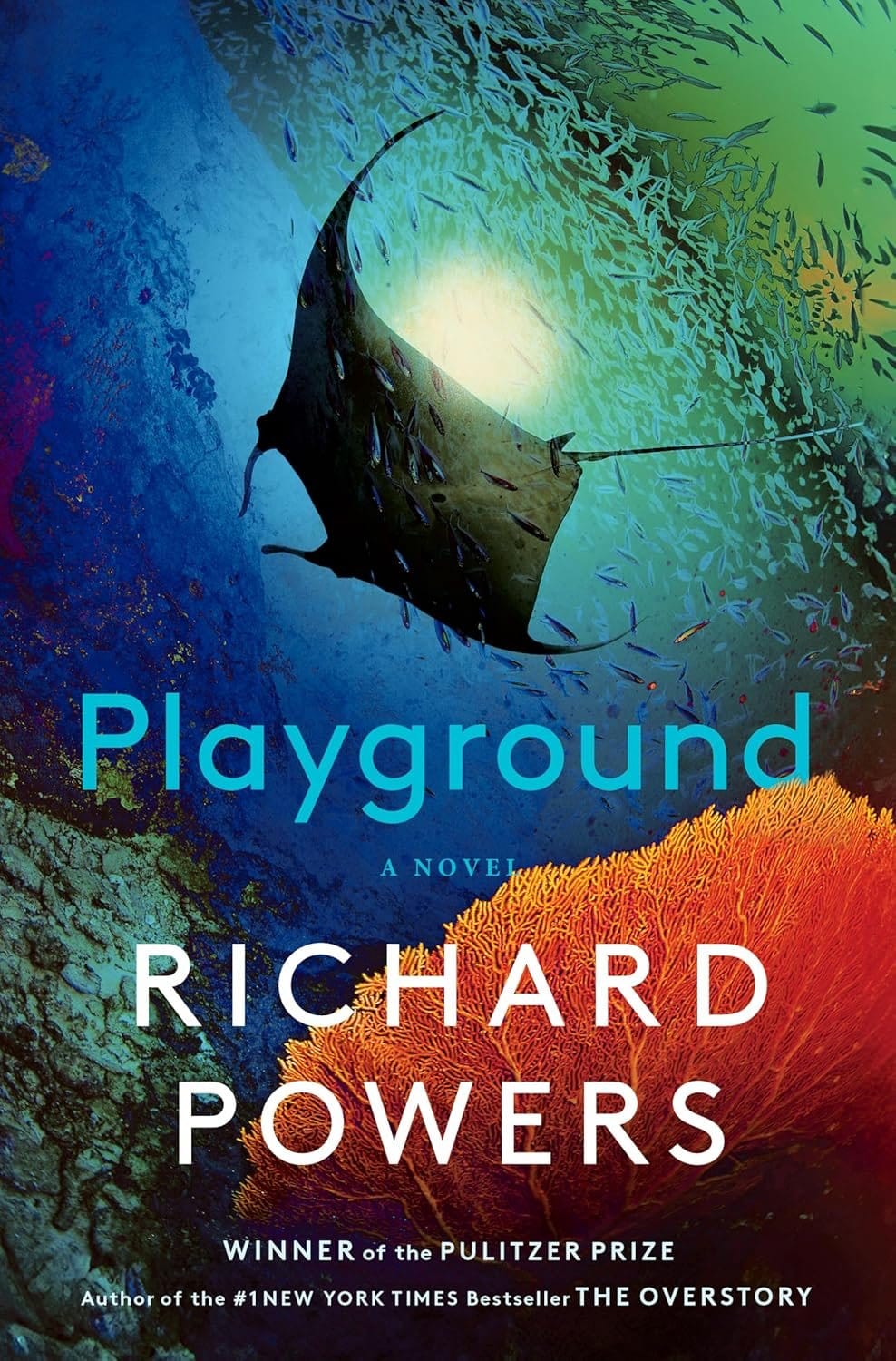
The book is immediately recognizable as Powers: there’s a gamer, a scientist, an artist, and an intelligent ecosystem. Some of the human characters are based on notable figures in the real world. There are questions of activism and morality threaded in a skein of human motivations and planetary defense.
Maybe its very Richard Powers-ness bred some familiarity that prevented it from being fully recognized for the powerful book it is. And true, there’s a touch of Gabrielle Zevin’s Tomorrow and Tomorrow and Tomorrow in Playground’s love triangle of genius gamers and artists. So maybe it didn’t break completely new ground.
Whatever the case, Playground is particularly apposite to the dangers we now face.
The unreliable narrator, Todd, is a childhood game prodigy who grows up to become a sort of Mark Zuckerberg-Peter Thiel amalgam after inventing a social network called Playground. He tells his story (and toward the end, you find out just how unreliable he is) from the vantage of later-in-life mental decline and quickly approaching death. He recounts betraying the best friend and game partner of his youth, Rafi, who followed the path of art and love while Todd moved toward technology and wealth. Rafi’s clever addition of gamification gave the social network the impetus it needed to sweep the world a là Facebook; Todd fails to give credit where it’s due and goes on to become so wealthy that, like our world’s Musk and Bezos, he is effectively no longer part of the human race. Except, of course, that he’s dying by the time he tells his tale.
I’ll leave the rest of the story’s gorgeous mysteries under wraps. Its sheer color rendered such vivid images in my mind that when I recall its scenes, I can’t immediately remember whether they’re from a movie I watched or a book I read. There’s a moment of interspecies play (my favorite kind) between a manta ray and one of the human main characters that I will never not think about.
The plot point that brought it to mind today, though, was the narrator’s plan to mine a small Pacific island for the materials needed to build an independent city-state on the open ocean. A seasteading. This is, if you’re not familiar with it, part of what the Silicon Valley techbroligarchy have been working toward for years, and it’s also sometimes known as the Network State after the book of the same name by tech power player Balaji Srinivasan.
San Francisco Bay Area journalist Gil Durán has labored in relative obscurity over the past few years chronicling the dark ideologies that drive so much otherwise inexplicable behavior by Silicon Valley tech lords. We are right, as a society, to ask ourselves: Does it make sense that the world’s richest person would need or want a job in the U.S. government nobly ferreting out fraud and waste? Reaching the obvious answer of No, our next step is to wonder what could be the impetus behind this new interest in federal bureaucracy—and whether there’s a risk of wider harm there. Durán’s work answers both questions, and the answers revolve around the Network State.
The brief explanation is that planet Earth itself, including ‘natural capital’ and ‘human capital’ and all physical ‘resources’, are viewed as pieces in a zero-sum game by the billionaire class. A thought experiment: consider any given government action intended to protect non-wealthy beings, including non-humans—say, forcing health insurance companies to cover those with pre-existing conditions, or regulating timber harvests to protect water and wildlife, or requiring companies like Amazon to provide worker safety equipment or reasonable overtime pay. Now ask whether that improves the billionaires’ financial position. Providing safety equipment for Amazon workers translates directly into fewer dollars in Bezos’ pocket. Restricting clear-cutting means less profit for timber companies.
Simplistically speaking, any government action that benefits any underclass (human or non-human) restrains the billionaire class in some way. This is obviously flawed short-term thinking, but I am trying to illustrate the thought process behind the Network State. It’s all about consolidating wealth and power at speed.
None of this is new, and it’s why activists have fought over the decades for labor laws, worker safety laws, restrictions on logging and mining practices, free education, and endangered species protections. Dumping toxic waste in a river is always cheaper than hiring a company to dispose of it properly; capital will always seek to externalize its costs upon the commons to minimize expenditure and to maximize profit. So capital must be firmly limited by external forces; that is, by the humans who are trustees of the commons. That’s all of us, and that’s what democratic government aims to do.
Until now, capital has succeeded in circumventing government regulation to varying degrees, and Project 2025 as currently being implemented is the culmination of decades of concerted effort to do just that. But for the billionaire class, particularly the techlords, Project 2025 does not go far enough. That agenda’s nearly realized goal of capturing the U.S. government’s administrative arm—and hamstringing its ability to (a) work for the people and (b) impose limits on corporate malfeasance—is a crucial step toward fatally weakening our institutions. But it is not the final goal of Musk, Bezos, Thiel, and cohort.
As Durán and others report, the Silicon Valley billionaires see the institution of democracy itself as the ultimate limit on their freedom to hoard the Earth for themselves. When the masses can speak and be heard, they tend to—through their elected governments—impose regulations on wealth hoarders. When capital corrupts democracy, government’s ability to impose limits decays. When pure capital takes human shape in the form of billionaires, their logical final step is to remove the impediment of democracy altogether.
In a recent piece, technology writer Mike Brock describes the work of Hans-Hermann Hoppe:
who took libertarian skepticism of the state to its extreme conclusion. His 2001 book Democracy: The God That Failed landed like a bombshell in libertarian circles. Published at a moment when many Americans still saw democracy as the “end of history,” Hoppe argued that democracy was an inherently unstable system, one that incentivized short-term decision-making and mob rule rather than rational governance. His alternative? A return to monarchy.
But this wasn’t the monarchy of old. Hoppe envisioned a new order—one where governance was privatized, where societies functioned as “covenant communities” owned and operated by property-holders rather than elected officials. In this world, citizenship was a matter of contract, not birthright. Voting was unnecessary. Rule was left to those with the most capital at stake. It was libertarian thought taken to its most extreme conclusion: a society governed not by political equality, but by property rights alone. [my emphasis added] [Source]
I’m struck by the historical parallels to this nation at the cusp of the Revolutionary War. In A People’s History of the United States, Howard Zinn writes of a Boston boiling toward revolution:
leaders of the movement against the Stamp Act had instigated crowd action, but then became frightened by the thought that it might be directed against their wealth, too. At this time, the top 10 percent of Boston’s taxpayers held about 66 percent of Boston’s taxable wealth, while the lowest 30 percent of the taxpaying population had no taxable property at all. The propertyless could not vote and so (like blacks, women, Indians) could not participate in town meetings. This included sailors, journeymen, apprentices, servants.
Extreme wealth inequality in a system where only those with wealth could participate (sounds familiar) led to an uneasy, taped-together national identity, trying to accommodate some form of democracy along with landed aristocracy. Those empowered by their ownership of property (land and/or wealth) would give just enough voice to the disempowered to secure their support in an uprising against the royalty and lords back in England who took a huge slice of the colonies’ profits. Zinn famously notes:
Around 1776, certain important people in the English colonies made a discovery that would prove enormously useful for the next two hundred years. They found that by creating a nation, a symbol, a legal unity called the United States, they could take over land, profits, and political power from favorites of the British Empire. In the process, they could hold back a number of potential rebellions and create a consensus of popular support for the rule of a new, privileged leadership. When we look at the American Revolution this way, it was a work of genius, and the Founding Fathers deserve the awed tribute they have received over the centuries. They created the most effective system of national control devised in modern times, and showed future generations of leaders the advantages of combining paternalism with command.
This somewhat Frankensteinian thing we call the American experiment was probably doomed from the start because it conceived a democracy adulterated by property rights, i.e., capitalism. (Many egalitarian Native American governmental systems thrived prior to European colonization without a system of property rights.) Seen this way, Musk, Thiel, Yarvin, et al.’s plan to end the American democratic experiment is an expected, if vile, outcome.
According to a memo circulated by anonymous government researchers last month, intended for a Congressional audience (and here’s my strong recommendation to read it from beginning to end):
Rather than operating as an ally of the Trump administration, Musk has hijacked its ambitions for his own purposes. His rapid takeover of federal infrastructure mirrors the broader ambitions of the neoreactionary (NRx) movement—a small group of Silicon Valley elites who reject democracy and seek to install a “CEO Monarch” to rule by technological and financial dominance. This network includes Peter Thiel, Marc Andreessen, Balaji Srinivasan, David Sacks, and Curtis Yarvin, among others. Once considered fringe, purveyors of this ideology have now been embedded into the core of government operations.
Musk’s maneuvering demonstrates a long-standing strategy of this elite class: not dismantling government, but replacing its power structures with ones they control. DOGE has not reduced bureaucracy—it has privatized it. Treasury has not been made more efficient—it has been placed under a billionaire’s influence. TikTok has not been secured from foreign threats—it has been delayed so Musk can position himself as its gatekeeper. President Trump, far from asserting dominance over the administrative state, may now find himself hostage to Musk. [Source]
One of the core ideas of the NRx movement is to build a network of corporate city-states that operate independently of any national government. Most importantly, these will be autonomous zones that determine their own paths to wealth and power. One can confidently assume that healthy ecosystems and human rights will not be high priorities within these enclaves, whether they’re built on land or, someday, as seasteads on the open ocean.
I missed this in 2024, but Trump was already talking about establishing independent “freedom cities” on the campaign trail. Now the idea’s back, and it plays into the planned privatization of public land we’ve been speaking about here for months. As Durán reported this week:
Donald Trump wants to build ten weird new cities on federal land. He calls them “freedom cities,” but that’s pure propaganda. These will be corporate-controlled enclaves that operate outside the normal rules of democracy—all for the benefit of tech billionaires. It’s an idea straight out of the Network State playbook. [Source]
Durán’s research is receiving sorely needed attention. The New Yorker recently picked up his work, for example, along with (finally) The New York Times, amid a surge of interest in what exactly Silicon Valley is up to. Names like Balaji Srinivasan, Curtis Yarvin, and Peter Thiel are filtering into our national consciousness, when we can find a moment to breathe in between news of the Trump administration’s extrajudicial deportations, opening an undeclared proxy war front against Iran, bellicose posturing against Canada, dismantling our public lands system, violating court orders, and firing federal employees en masse.
The Times quotes Durán as follows:
Having realized that money buys political power, these tech billionaires are now trying to buy the entire U.S. government. This is an unprecedented hostile takeover. With Elon Musk as their avatar, they openly dismantle the government and disregard the Constitution. They pose an existential threat to American democracy, and they see this as their moment to seize power.
Many of the tech billionaires who have merged with Trump believe democracy is an outdated software system that must be replaced. They want a future in which tech elites, armed with all-powerful A.I. systems, are the primary governing force of the planet.
“The tech oligarchs, Duran argued,
are an existential threat to democracy. Look at the news. It makes no sense that a presidential administration would seek to crash the economy while allowing an unelected foreign-born billionaire to rip apart the government. This goes against every rule in politics. Trump’s poll numbers are sinking yet he’s taking no steps to correct the course. This is the logic of a suicide bomber.
These billionaires, Duran argued, ‘are fully in control of Trump’s MAGA party,’ but their ambitions go beyond that. ‘The Republican Party is simply a host organism for the parasite of tech fascism,’ Duran wrote, but ‘it’s not just the Republican Party that’s lost its soul. The tech authoritarians are also moving to co-opt leaders in the Democratic Party.’” [Source]
In my opinion, it’s well worth an afternoon of everyone’s time to turn off the news feeds and dive into Durán’s work. Only by being accurately informed can we resist effectively, on our own behalf, but also on behalf of all the humans and non-humans who are impacted when the U.S. acts.
Paris-based American journalist Alexander Hurst writes:
Non-Western states may shed few tears for the domestic breakdown of the rule of law and the rise of fascism in the U.S., or the dissolution of a world they often saw, and rightly so, as hypocritical. But at the very least, international law and norms against aggression and for human rights exerted enough power for there to be hypocrites. This generation of American techno-nihilist oligarchs will not content themselves with the United States alone. Having seized its apparatus, they are using its power to prey upon the world as a whole. [Source]
There is still time, but the hour is growing late. Our ignorance only emboldens those who would re-engineer the U.S. government, and ultimately, the entire world for their benefit. Knowledge is power. Share it, and then add your voice, in whatever way you’re able, to the chorus of those calling to get Musk and Co. out of our federal government.
Talk to you soon,
Owl
Sources:
Richard Powers. Playground. W.W. Norton, 2024.
Howard Zinn. A People’s History of the United States. Harper Perennial, 2015.
Anonymous Memo. “Capture of U.S. Critical Infrastructure by Neoreactionaries.” Feb. 5, 2025:
https://america2.news/content/files/2025/02/Musk-NRx-Memo-February-5-2025.pdf
https://newrepublic.com/article/183971/jd-vance-weird-terrifying-techno-authoritarian-ideas
https://www.thenerdreich.com/the-network-state-coup-is-happening-right-now/
https://www.thenerdreich.com/memo-capture-of-u-s-critical-infrastructure-by-neoreactionaries/
https://nymag.com/intelligencer/2020/01/peter-thiel-conservative-political-influence.html
https://www.nytimes.com/2025/03/18/opinion/andreessen-musk-trump-silicon-valley.html?unlocked_article_code=1.5E4.Mobx.51OrBbBzXVaQ&smid=url-share&ref=thenerdreich.com
*Inspired by historian Heather Cox Richardson's Letters from an American
Owl in America will remain free to all readers. Paid subscriptions help make possible the time it takes to track agency notices, court filings, specialized reporting, and environmental stories that can be easy to miss. If you can support this work with a paid subscription, thank you; if you can’t, thank you for being here. Please share these letters, speak up where you can, and keep paying attention to the living world. 🦉



Member discussion