
October 23, 2026
Notes from an American environmentalist ✦ 3.5% protest rule ✦ Flamingo Revolution ✦ COP17 biodiversity conference

These Notes from an American Environmentalist trace the actions of the current U.S. administration from the perspective of an environmental lawyer.
In today's letter, I take a look at the protest movements sweeping the globe. Meanwhile, delegates gather in Armenia at the UN biodiversity conference.
Hello all~
I recently learned about the '3.5% Rule.' Simply stated, it's the proposition that if more than 3.5% of a country's population mobilizes against a government in a peak event, that government will fall. The claim is sometimes overstated as "no government has ever withstood such a mobilization," but that is not strictly true.
A 2020 analysis by the rule's creator, Dr. Erica Chenoweth at the Harvard Kennedy School, clarifies that Bahrain's popular movement to overthrow its government in 2011-14 reached 6% of the population but failed. In every other example, however, the threshold of 3.5% held true, so long as it happened during a so-called peak event.
https://www.hks.harvard.edu/sites/default/files/2024-05/Erica%20Chenoweth_2020-005.pdf
For the purposes of this analysis, a 'peak event' denotes a singular mass demonstration, rather than cumulative participation numbers over weeks or years. Dr. Chenoweth's measure of success is that in response to the mass mobilization, the incumbent left office.
Chenoweth cautions that the rule is descriptive, not proscriptive, meaning that they analyzed past successful protest movements up to the present but are not asserting that the rule must always hold true in the future. And, the paper emphasizes that "other factors—momentum, organization, strategic leadership, and sustainability—are likely as important as large-scale participation in achieving movement success and are often precursors to achieving 3.5% participation."
Still, it's a fascinating guideline. 3.5% of today's U.S. population would be well over 11 million people. For context, the Washington, D.C. Women's March in early 2017 drew over 4 million people, just over 1% of the population.
Last week's No Kings demonstrations reportedly drew up to 7 million participants. A doubling might just do the trick. Dr. Chenoweth explains that 3.5% participation can be seen as the tip of an iceberg—those that hit the streets in protest are likely representing a swath of others who are dissatisfied with the leader but are more risk-averse and less likely to protest. A visible iceberg of 3.5% thus apparently represents an invisible underwater mass big enough to sink even an autocrat, as Chenoweth says has happened scores of times in the postwar period.
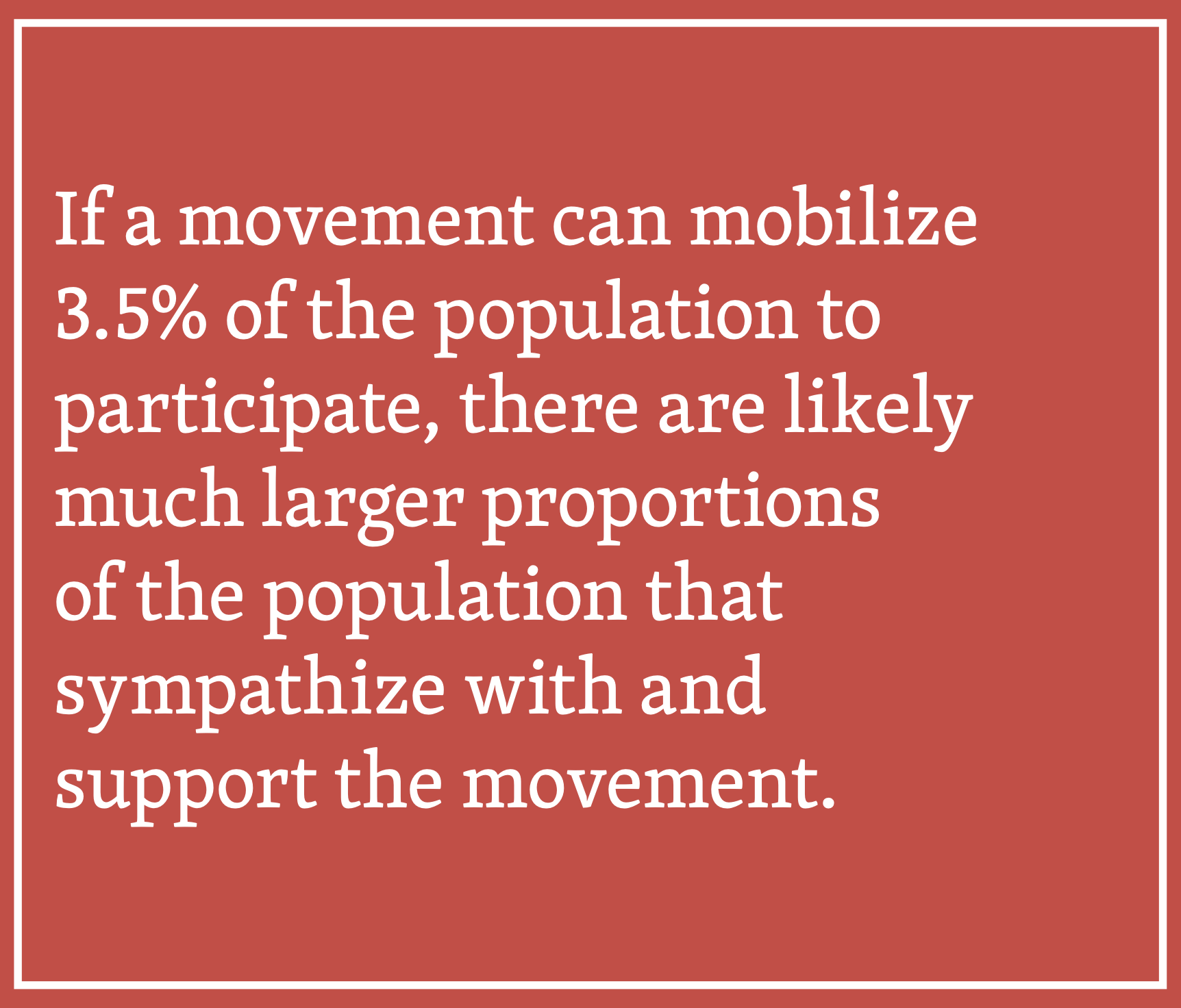
Student protests in France are the major topic of international news, but I am still keeping an eye on Albania, whose Flamingo Revolution is now in its fifth month. I wrote about the background and aims of the protests here and here.
The upshot is that this very poor Eastern European country—that only emerged from behind its particularly brutal Iron Curtain in the early 1990s—is demanding a new government. Beset by autocratic backsliding as it continues its democratic transition, its citizens are demanding the current prime minister Edi Rama resign over corruption charges.
A pair of massive resort complexes being built in a national park by a Kushner- and Trump-backed investment firm sparked off the protests. Prime Minister Rama's administration has been accused of general corruption and of slipping an exception into Albania's conservation laws allowing high-end construction in protected zones, reportedly at Kushner's behest.
Albanian students have boycotted the start of the university term, adding more young people to a movement that was composed primarily of Gen Z citizens as well as Albanian expats living overseas who have returned in support of the movement for democracy.
The protests, which had remained nonviolent for four months, suddenly turned violent in the past week. Arrests, along with injuries, have ramped up. Last weekend, protestors set fire to Albania's Supreme Court, blaming it for a decision to allow the planned construction for Jared and Ivanka's resorts to go forward.
On Democracy Now!, Albanian labor leader and organizer Bora Mema said, "Students find no future in Albania. Many of us have to migrate because the only development model that the government proposes is to clean the toilets of the rich and the mafia in luxurious resorts, like the one that Trump and Kushner and the national oligarchs and mafia in Albania are constructing."
Prime Minister Edi Rama has so far refused to resign, saying he is the only person who can steer Albania to its planned accession into the European Union in 2030. In fact, the European Commission has warned that the corrupt legal structure Rama backed, allowing for Jared and Ivanka's resort construction in Vjosë Wild River National Park, violates EU conservation laws, and may prevent Albania from joining the union.
Rama has also tried to tar the youth movement as improperly influenced by Antifa, in what is regarded as a way to appeal to President Trump and his family: "They are young men and women who have ideologized and radicalized under pressure or inspiration of the dark and new force that has emerged in Europe and the United States, which the president of the United States has designated a terrorist organization: antifa."
I suspect this will backfire on him: the Albanian democracy movement is proudly anti-fascist.
The total population of Albania is just about 2.75 million. 3.5% of that equates to only 96,250 people needed in the streets. I haven't seen any good estimates of the size of the protests, but I wonder if they're not far off that number.
Meanwhile in Yerevan, Armenia, the 17th Conference of the Parties (COP17) for the UN Convention on Biodiversity (CBD) is concluding its first week. Back in 2024, COP16 disbanded early. Delegates were unable to agree on a funding mechanism for biodiversity efforts, with the Global South bloc pushing for a separate finance structure under the direct control of the UN convention. The conference picked back up in Rome in 2025 and agreed on a roadmap to a permanent funding mechanism.
Now, in 2026, the Convention on Biodiversity has found that countries are still not on track to meet 22 out of 23 biodiversity targets by the 2030 goal date.

Carbon Brief is tracking the status of the provisions currently under negotiation in Yerevan in a color-coded chart, below. It links to each of the draft texts. Green indicates that few areas of disagreement remain; red is the opposite. Delegates will meet through October 30.
 Carbon Brief Staff
The 2026 Living Planet Report, produced by the World Wildlife Fund, is subtitled "The Science of Hope." It finds ongoing massive declines in wildlife populations since 1970, especially stark in Central and South America, the Caribbean, and Africa. But it leavens this dismaying data with cause for renewed vigor: it gives examples of several species that have recently rebounded as a result of conservation efforts, including tigers, bluefin tuna, and green sea turtles.
The report concludes:
https://wwflpr.awsassets.panda.org/downloads/living-planet-report-2026-english.pdf
Take a look at the Photo Ark if you need a little inspiration for your own sense of hope, to motivate the good work you are doing in the world:
 Kate Mothes

A final note:
The Center for Western Priorities recently released a report showing that 99.1 percent of public comments submitted to the Forest Service opposed the Trump administration's proposed repeal of the Roadless Rule. Only 1,922 comments, out of approximately 370,000, supported rolling back the rule.
The report also notes that conservation groups tracked well over a million comments opposing the rollback. Some of these may have been duplicates, but the majority were likely form submissions that were not posted to the government's portal directly.
That's what I call a public outcry.
Talk to you soon,
Owl

Notes from an American Environmentalist will remain free to all readers. Please share these letters, speak up where you can, and keep paying attention to the living world. 🦉