Owl at the Library
Quick note to all subscribers: If you tried to respond directly to my most recent newsletter, I may not have received it. In the transfer to a new hosting site, I accidentally misconfigured my reply-to address. It seems to be up and running now, so please reach back out if you tried to contact me by email and never got a response.
Also, for those who were paid subscribers to Fearless Green, I have set you up here at Owl in America for a complimentary year. There will be no automatic renewal. When that year is up, you are welcome to stay on as a free subscriber or sign up for a paid membership. Thank you so much for your past support! Please reach out if you have any questions.
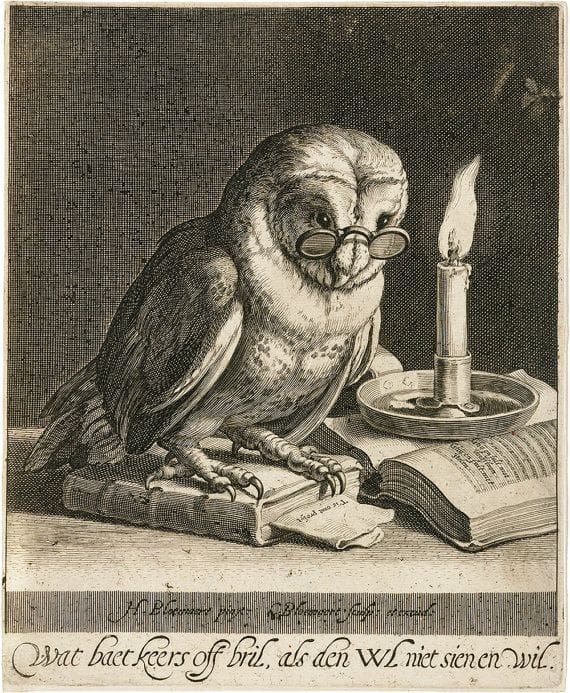
"Owl! at the Library" was the name of a Twitter account I once loved, now evidently vanished into the black void of X. In honor of that bookish, sharply humorous, yet kind and cozy observer, I want to incorporate some thoughts from my personal reading curriculum into these newsletters.
I have recently relocated to a very small town. One day, while I was sitting in our tiny public library, the layout of the nonfiction section caught my eye. Comprised of five shelving units in total, each about four shelves high, it stretched along a single wall. Hmm, I wonder how many books are here? What if this tiny library's nonfiction section held all the knowledge available to the town? Could a person get a full education using these books alone?
How long might it take a dedicated reader to complete the entire nonfiction section? Five years?
Acknowledging the gaps in my knowledge—particularly in the humanities—I'm always looking for paths to self-education. I recently organized my nonfiction TBR list into a thematic reading plan for the year, but something felt off. It was too full of books I wanted to read. It lacked the rigor of outside assignment, that particular resistance book lovers feel when they crack open a book they must read rather than one they want to read.
I haven't really felt that pain since law school. And in my experience, pushing through it typically rewards the reader with a new way of thinking, like discovering a previously hidden room in one's house.
Sitting in our adorable library a few weeks ago, it occurred to me that I could use the Dewey Decimal system like a curriculum, with its nonfiction holdings as my textbooks. But how would I actually do it? Just start from the beginning and try to read through the stacks in order?
I wandered over to the shelves to see what I might be getting into. At the very beginning were a few books in the 001 section, Knowledge and General Learning. The first, at 001.96, was Pandora's Lab: Seven Stories of Science Gone Wrong. According to its blurb: "History is filled with brilliant ideas that gave rise to disaster, and this book explores some of these missteps." Interesting, though not a topic I would normally make space for in my limited reading time.
But then over on the new release shelf, not yet filed into the stacks, I saw 001.942, Imminent: Inside the Pentagon's Hunt for UFOs, written by a "former senior intelligence official and special agent who was recruited into a strange and highly sensitive US Government program . . . ." It would be shelved before Pandora's Lab. If I committed to this plan, I'd have to start with this UFO book.
The idea of a full nonfiction read-through started to lose its luster. Moving on, I was mildly interested but not exactly fascinated by the rest of the options on the 001–099 shelves. But then I realized that was actually the strength of this plan. It would force me to visit areas into which I'd never normally venture, like off-the-beaten-path travel, but for my brain!
A few months ago, I forced myself to finish the epic nonfiction book The World by Simon Sebag Montefiore. I say forced, not because it's badly written; the opposite is true. But the subject matter is pretty bleak: it's a retelling of world history through the lens of families in power, and families in power tend to behave terribly (no surprises there). While disheartening, it nevertheless demonstrated that this current group's rapacity is par for the course of human history—a bit comforting, in a counterintuitive way.
I followed it up with The Earth Transformed by Peter Frankopan, which is another overview of world history, but told with reference to the environmental transformations humans bring. At times, it too was rather disheartening, for obvious reasons.
It occurred to me that I might like to follow those sweeping, big-picture books with some modern world history from the 20th century forward to help me trace more granularly what so many Americans are asking ourselves: How in the heck did we end up here? So, with that in mind, I wandered down to the other end of the nonfiction stacks and found myself in the 900s, where history lives.
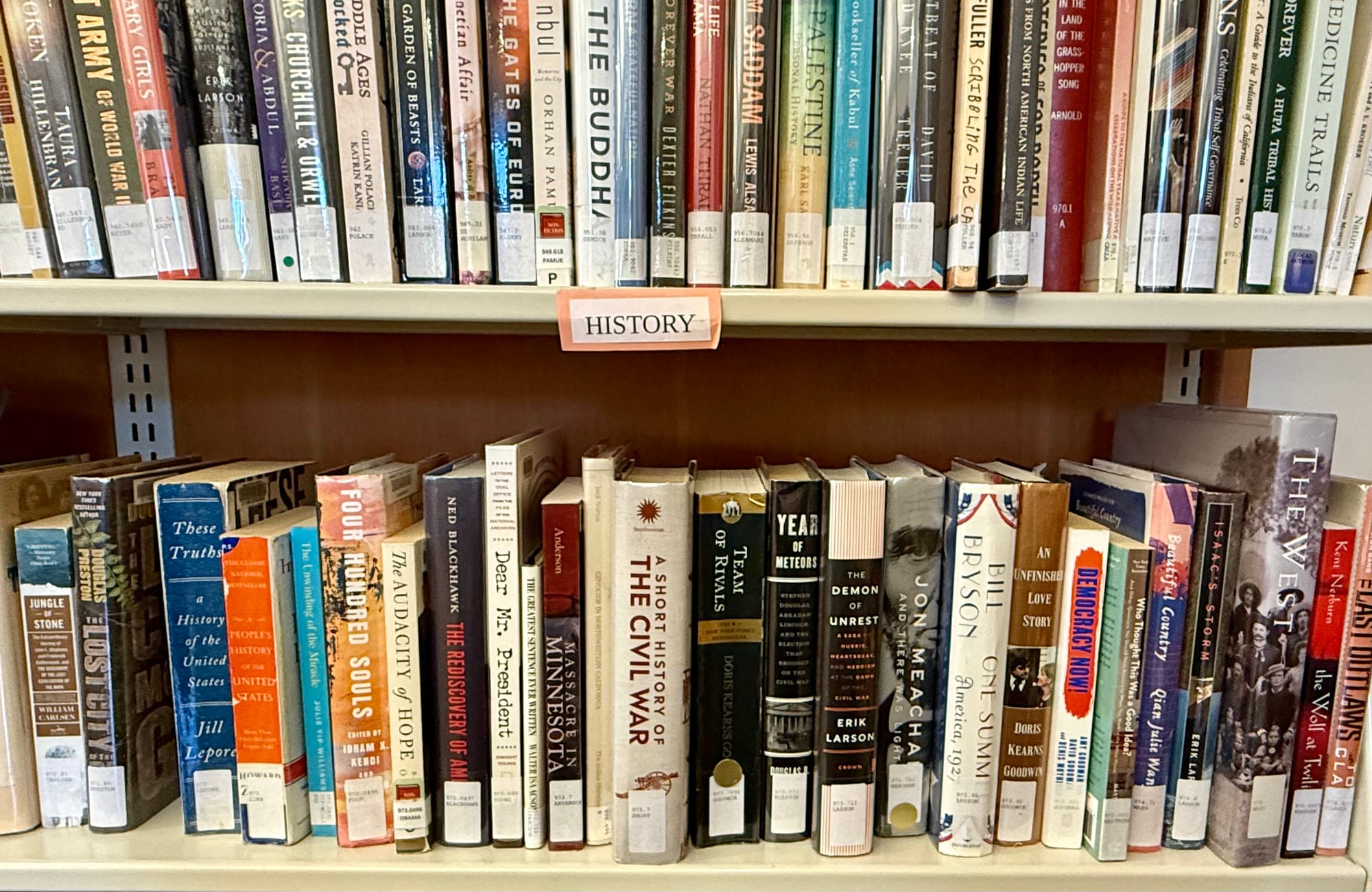
My tiny library doesn't even have a book for every major segment of history found in the Dewey Decimal system, but I found that the 940s section had some modern history books focusing on Europe. If I started there, I could work forward from the World Wars, a perfect starting point for understanding our current departure from the post-1945 world order. Then, after reading the two shelves remaining at the end of the nonfiction section, I would be at the end of the stacks and could start at the beginning (with that UFO book, I guess).
There are roughly 500 books in the entire nonfiction collection, I estimate. To keep it manageable, I'll omit certain types of special-interest or reference books: manuals, how-to books, self-help books, encyclopedias, gardening guides, cookbooks, and travel guides. I imagine maybe 300 books remain after removing those.
The first book in the 940: History of Europe section was The Monuments Men: Allied Heroes, Nazi Thieves, and the Greatest Treasure Hunt in History. It tells the story of a group of British, American, and French artists, soldiers, and curators who recovered much of the European art and artifacts looted during the Nazi occupation of Western Europe. I can affirmatively state there is no chance I would ever have picked up that book, much less read all 640 pages of it. Military history and art: two subjects I know little about and—however interesting individually—would not typically care to read about in tandem.
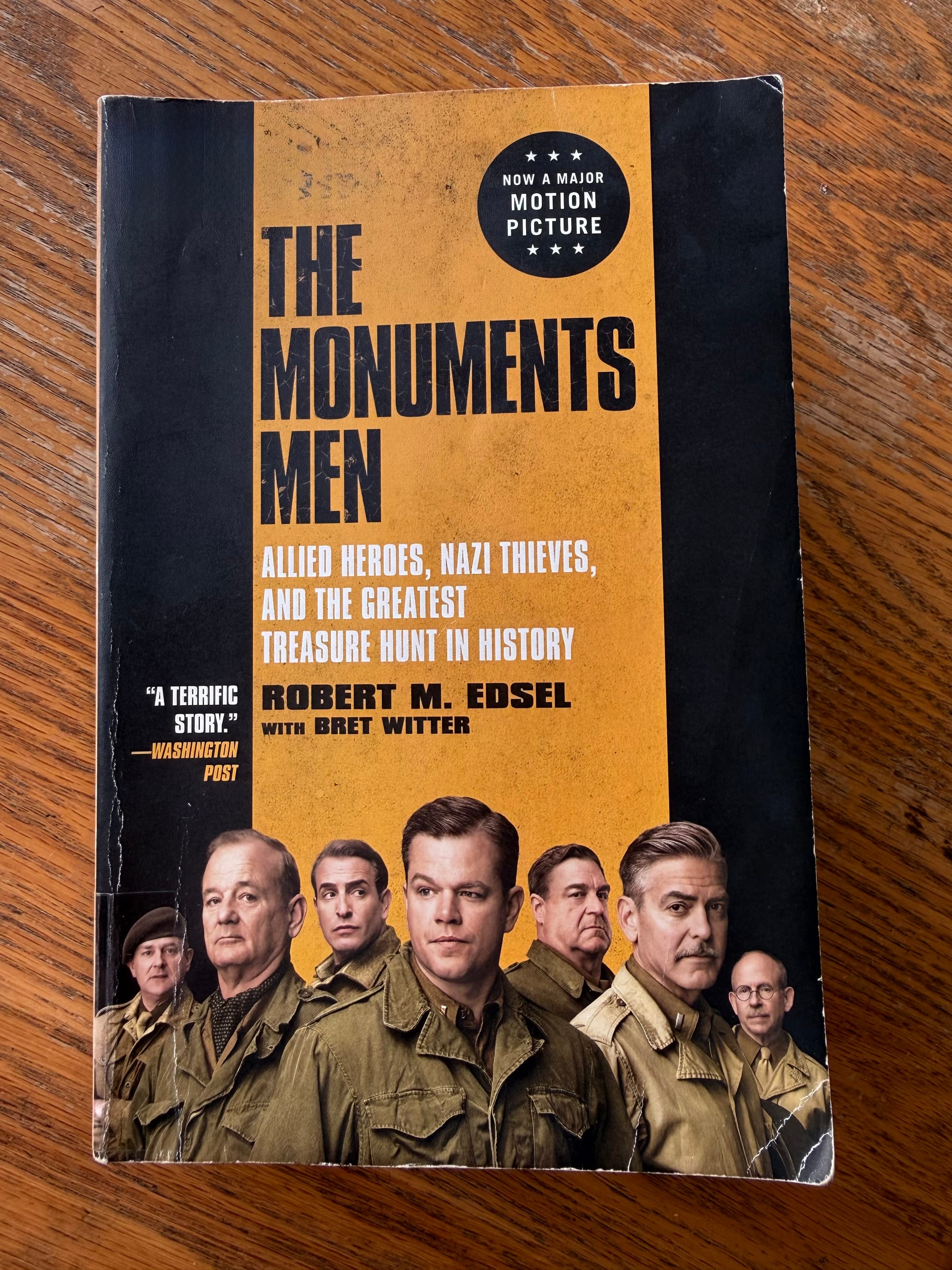
And yet! I checked it out so I could give this Owl book project a test run, and it ended up being one of the best books I've read in years. It highlighted the best in people, and as to Americans in particular, I needed to recall that we can be good—and do good—for the world. I learned a ton about the final year of the war in Europe, the machinations of the retreating Nazi army, and the cultural and religious treasures that were dangerously close to being lost forever. And I appreciated the reminder that we've thrown off belligerent regimes before. We can do it again.
Maybe I just got lucky with the first book, but at any rate, the project is off to a good start. Next up (and I will need to take a few deep breaths for this one): The Escape Artist: The Man Who Broke Out of Auschwitz to Warn the World.
I'll share what I find as I go.
Owl in America will remain free to all readers. You can subscribe directly below, choosing a free or paid subscription. Tips of any size can be left in the tip jar, and will be received with great thanks. 🦉


Member discussion