July 26, 2026
Owl in America is a series of letters tracing the actions of the current U.S. administration from the perspective of an environmental lawyer. These notes follow how, in a time of rapid political and ecological change, governmental decisions are felt in the living world.
Hi all~
Since starting this series of letters just after Trump was re-elected in late 2024, I've tried to carry through a theme of action. For my motto, I've kept in mind Maxine Hong Kingston's words:
In a time of destruction, create something.
The full quote: "Children, everybody, here's what to do during war: In a time of destruction, create something. A poem. A parade. A community. A school. A vow. A moral principle. One peaceful moment."[1]
I'll add: A prairie habitat. A garden. A micro-forest. A community land trust. A restored stream. A wildlife rescue.
All of these are actions we can take in a time of war, and I don't just mean war between humans. Capitalism has been at war with the natural world since its inception. It has accelerated over the last century, and with the current leadership in the U.S., its outcome is ever more in doubt. The defensive laws and institutions we thought would remain steady are crumbling under sustained and multi-pronged attack. The Endangered Species Act, the Antiquities Act, our land management agencies, the Environmental Protection Agency, the wildlife service: all are at risk of failure in the next few years. (Were they perfect? Far from it. But the edifice took years to build and was once the most progressive body of environmental protections in the world.)
The impacts of global warming become more real each year. As I write, wildfires darken the skies across North America while French and Spanish residents evacuate from fast-moving wildfires. Much of Europe swelters. Ocean temperatures in the Southern Hemisphere have risen drastically in recent months. More evidence points to a slowdown of crucial Atlantic currents that keep the climate stable.
Some people prefer not to use the language of violence, of the military, in describing environmental issues. While I respect and understand this preference, I find it naive. Far better, I think, to recognize we are in dire circumstances in a war we never chose that we are in serious danger of losing. And in that recognition, to take creative action anyway. Embattled, we can still work to trace ways forward.
The enviro news this week is full of the president's horrific acts on two fronts: national monuments and endangered species regulations.
Receiving somewhat less attention, the administration has also gone after the National Historic Preservation Act, which, while sounding rather dull, is a key law that has protected Native American cultural sites. (It also requires a formal process before building such structures as Trump's planned Triumphal Arch in D.C., which may explain this action, at least in part.)
The Act provided another layer of protection from destruction through mining, drilling, etc., alongside national monument designations. Sites such as the protected buffer zone around Chaco Culture National Historic Park (a UNESCO World Heritage Site) would become vulnerable to this administration's "energy dominance" agenda with its associated oil and gas exploration and drilling.
The lands and ancient or historic structures within the former boundaries of Bears Ears and Grand Staircase-Escalante National Monuments—but now stranded outside the new, smaller boundaries—also lose one of their last remaining layers of legal protections from exploitation. While flawed, the historic preservation law at least required prospective drilling plans to include archaeological surveys for potential sites of historic interest. If any were located, it required federal land agencies to consult with tribal nations and work on plans to mitigate or avoid any damage to culturally important sites.
https://www.landdesk.org/p/trump-looks-to-gut-a-key-historic
But back to Bears Ears and Grand Staircase-Escalante National Monuments. My most recent letter focused on Trump's proclamation shrinking the two national monuments to a tiny fraction of their former size and the terrifying legal strategy this sets in motion.
https://www.owlinamerica.com/july-18-2026/
Trump's executive order changes more than the map. Another really worrying facet is that it erases an innovative co-management structure for the monuments. Recall, Trump shrank the two national monuments—created by Obama and Clinton—during his first term. Biden restored them and with Interior Secretary Deb Haaland, created a new management framework for Bears Ears in which the Hopi, Navajo, Ute Indian Tribe, Ute Mountain Ute, and Pueblo of Zuni tribal governments formed an intertribal commission that equally shared decision making with the federal government.
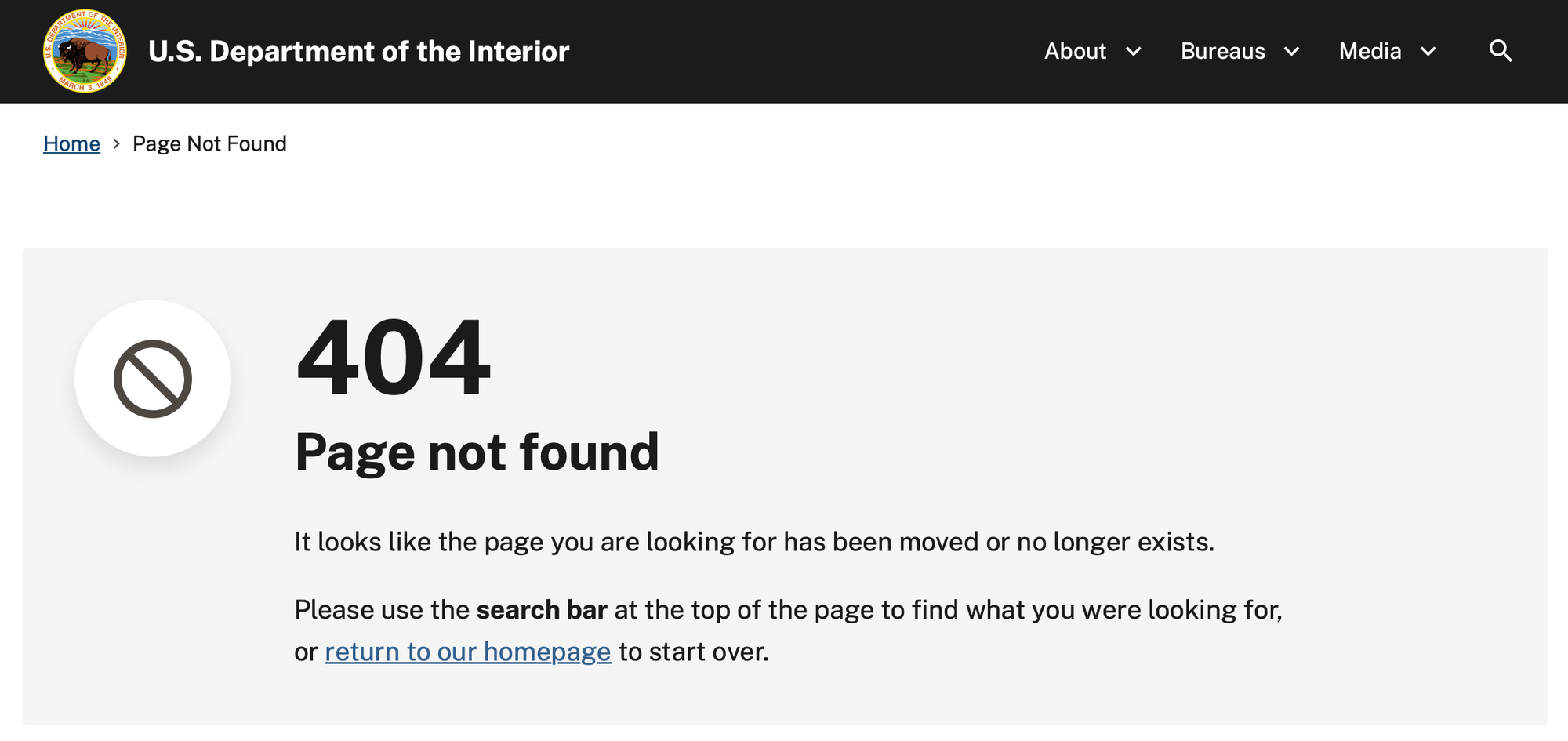
Trump's order dissolved the intertribal commission. When I returned to the federal website where the co-management agreement lived until a few days ago, it had been removed:
It is archived, however, at the Grand Canyon Trust's website:
Christopher Keyes and Campbell Leonard make the point that these actions continue a trend of Native erasure that is running in parallel with the energy dominance agenda on our public lands. Their recent piece for Re:Public outlines the case as described in the subtitle: "Five years ago, Native governance of public lands seemed possible. Now it's being systematically dismantled in the name of energy dominance."
https://www.republic.land/from-haaland-to-erasure/
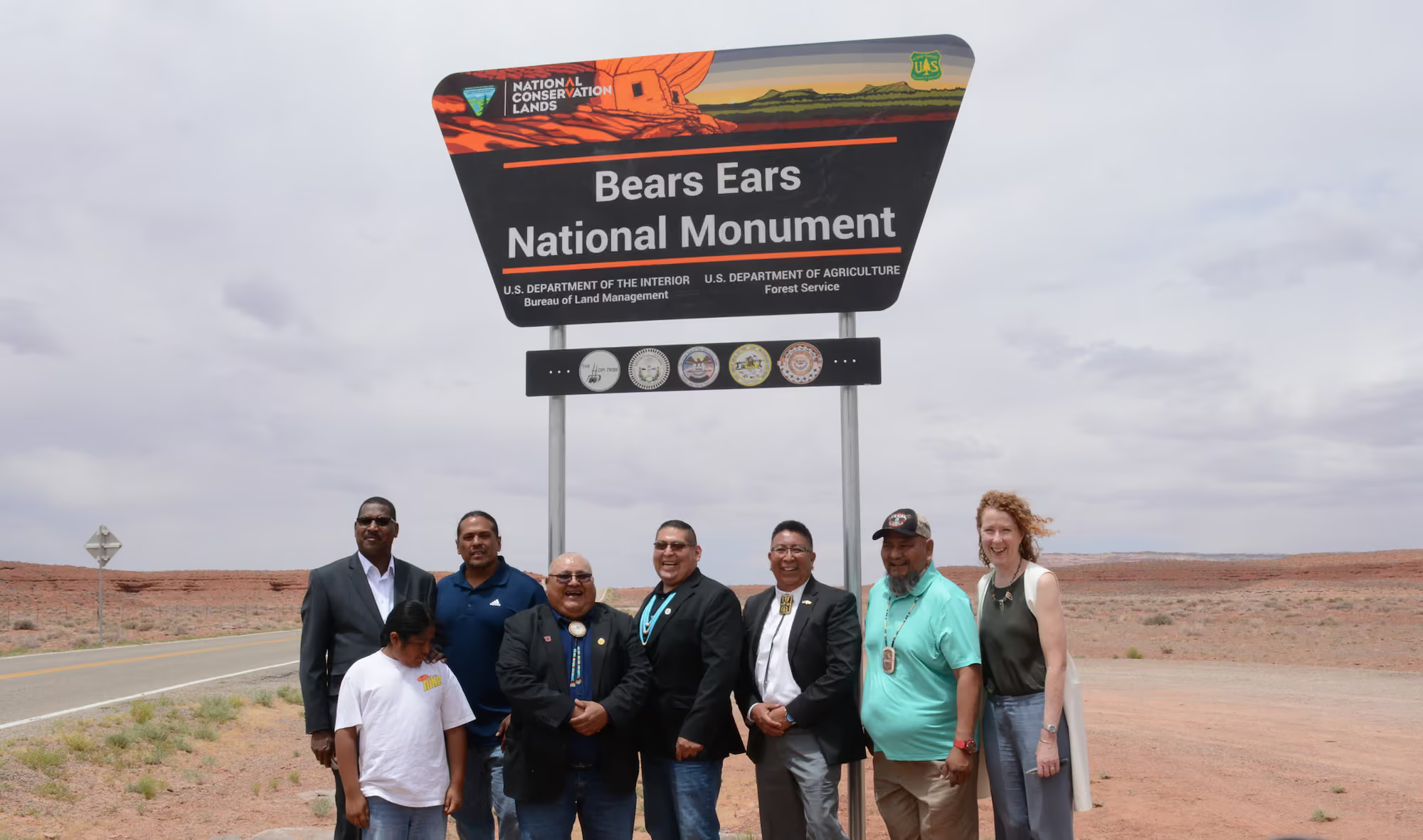
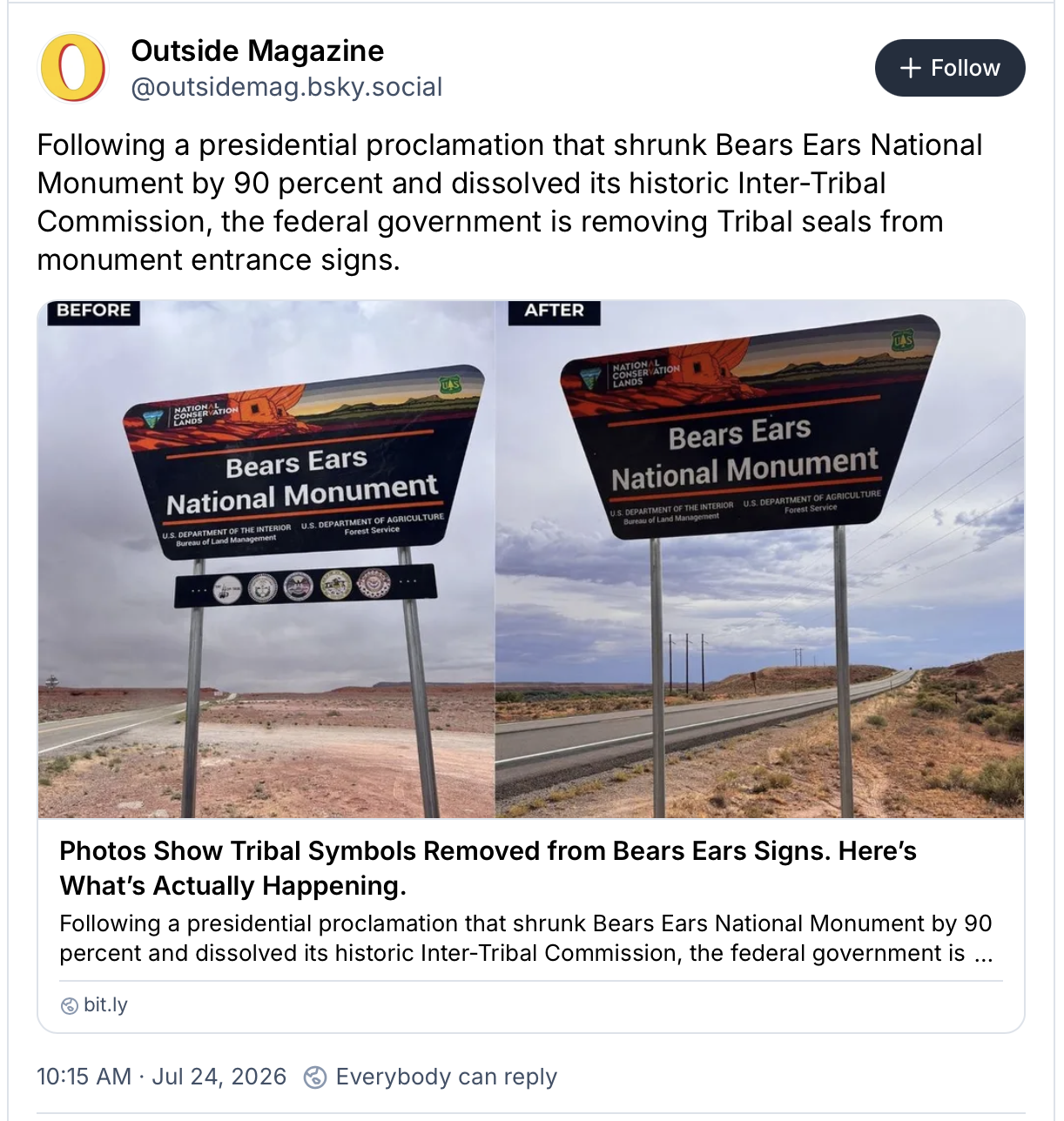
Within days of the proclamation shrinking the monuments last week, the signs for the co-managing Tribes were removed from monument signage.
https://www.sltrib.com/news/environment/2026/07/23/trump-administration-removes
Former Interior Secretary Deb Haaland, who played a key role in creating the tribal co-management agreement, identifies as a 35th-generation New Mexican in the Laguna Pueblo Tribe and is currently running for governor of her home state as a Democrat.
I think it's fair to say that until we have different leadership in D.C., some of these changes are here to stay. That shouldn't stop us from protesting and writing letters and calling our representatives and litigating. But also—while keeping in mind the appalling injustice of the administration's current actions—I want to highlight some of the many ways Tribes are working despite the federal government to heal the earth.
An interesting aspect of the Land Back movement, in which Tribes reclaim their ancestral lands, is that tribal governments frequently re-acquire lands in order to rewild them. That is, they often intend to share the land with wildlife and in some cases, to dedicate it completely to nature.
The Stillaguamish Tribe in coastal Washington state has been purchasing farmland in order to flood it, with the goal of creating salmon habitat. At the mouth of the Stillaguamish River, the Tribe removed nearly two miles of levees that had held back the ocean from farmland hosting, most recently, a dairy operation. Within minutes, the tidal flat welcomed tidewater for the first time in over a century. Now a restored 230-acre wetland will provide nursery habitat for young Chinook salmon.
The Stillaguamish gave up almost all of their ancestral land in exchange for fishing and hunting rights in an 1855 treaty with the U.S. government. But the 20th century brought massive ecological degradation through logging, mining, and dam-building that left many West Coast salmon runs on the brink of extinction.
Joint federal, state, and tribal efforts—like the Klamath dam removal process in California and the Elwha River dam removal in Washington—are making a difference for salmon recovery. In parallel with these, tribes are taking matters into their own hands. The Stillaguamish Tribe's official reservation itself is less than 100 acres, yet in the past decade, it has purchased over 2,000 acres of land for wildlife habitat. The Tribe are planning to purchase and restore even more lands than they have to date.
In far Northern California, the Quartz Valley Indian Reservation, which sits on just 200 acres, has received a $25 million loan from the state to purchase almost 40,000 acres of their ancestral homelands from an investment firm. The land shelters the headwaters of the Scott River, an important salmon stream, and has long been subject to logging. The state loan is conditioned in part on tribal watershed restoration work.
The Tribe has also announced it will open the land up for hiking and camping. Tribal Chairman Leonard Lincoln said, “People who want to come up from other parts of the state or country are welcome. It’s beautiful. It should be for everyone to enjoy.”
https://www.sfchronicle.com/california/article/quartz-tribe-land-klamath-22358342.php
The deal above is the second largest land-back deal in California history. The largest closed last year and finalized the Yurok Tribe's acquisition of 47,000 acres of ancestral lands around Blue Creek, an important tributary of the Klamath River. Previously owned by a timber company, the land had been heavily logged for decades, belying its importance as salmon and other wildlife habitat.
The Tribe is already practicing restoration forestry to heal a century of logging and has set aside about 15,000 acres at the confluence as a salmon sanctuary. In concert with the Klamath dam removals nearly 200 miles upstream, conservation here will improve the chances that returning ocean salmon will reach their natal streams to breed. The land deal just about doubles the Yurok Tribe's total territory.
https://www.sfchronicle.com/california/article/yurok-tribe-land-blue-creek-20343317.php
These are just a few stories. There are so many more. In them, I see examples of ways forward in spite of the sustained attacks on our public lands system. I also see real leadership in service of life and wonder what lessons those of us who are not part of a tribal nation can take from this?
As always when examining the harmful actions of the Trump administration the question comes up: Why are they doing this?
Ryan Busse's well-reasoned piece concludes there's a trio of reasons behind all of it: corruption, bribery, and corporate greed. He traces several examples through to the same source: gutting the Endangered Species Act, opening the Arctic National Wildlife Refuge to road building, and pushing for mining in the Boundary Waters Canoe Area. To his list, I'd add reversing Native stewardship on public lands. Why? Because in general, and especially in coalition, tribal nations stand against, and in the way of, destructive extraction.
https://ryandbusse.substack.com/p/investigative-report-why-republicans
[h/t Antonia Malchik]
In another example of moving forward despite federal chaos, California is currently considering legislation that would allow the state natural resources management agency to share funding for habitat conservation programs with Tribes. It would also clear the way for the state to enter into contracts in which Tribes could manage state-owned lands.
The brief podcast below gives an overview of the idea of indigenous stewardship as a conservation strategy. It also introduced a term that's new to me: "rematriation." (My autocorrect insists it's "repatriation.")
https://podcasts.apple.com/us/podcast/econews-report/id1488275574
If any readers know of similar state efforts taking place elsewhere, please let me know by commenting below, replying to this email, or tagging me on Bluesky. I'm collecting examples of other conservation paths now that progress at the federal level is blocked for the time being. I'd also love to hear more stories of Tribal land-back and conservation work, so please share any links or info.
A Biden-era effort to standardize access to map data for our public lands is now live, hosted by the U.S. Geological Survey. You can click around to play with map layers and data to visualize boundaries, habitats, topographic features, and much more.
https://www.usgs.gov/programs/national-geospatial-program/national-map
Talk to you soon,
Owl
[1] Kingston, The Fifth Book of Peace (2003).
Additional Sources:
https://podcasts.apple.com/us/podcast/econews-report/id1488275574?i=1000778338385
Owl in America will remain free to all readers. Paid subscriptions help make possible the time it takes to track agency notices, court filings, specialized reporting, and environmental stories that can be easy to miss. If you can support this work with a paid subscription, thank you; if you can’t, thank you for being here. Please share these letters, speak up where you can, and keep paying attention to the living world. 🦉

Member discussion